
Singapore has become one of the most popular places in the world to set up a company, and increasingly, Sri Lankan entrepreneurs, freelancers, and business owners are looking at it as their next step. Whether the goal is to serve international clients more easily, open doors to overseas investors, or simply build a company with a strong, trusted reputation, Singapore checks a lot of boxes.
This guide walks you through everything a Sri Lankan citizen or resident needs to know before starting a company in Singapore in 2026 — from the legal structures available, to the paperwork, the costs in both Singapore Dollars (SGD) and Sri Lankan Rupees (LKR), banking, visas, and the local foreign exchange rules that Sri Lankans specifically need to be aware of. It is written in plain language, without unnecessary jargon, so that even if this is your very first company, you will be able to follow along.
Why Sri Lankan Entrepreneurs Choose Singapore

Sri Lanka has a talented and increasingly global pool of entrepreneurs, particularly in technology, apparel and export trading, consulting, and financial services. Many of them run into the same wall sooner or later: local banking restrictions, foreign exchange controls, difficulty accessing international payment gateways, and limited credibility when pitching to overseas clients or investors.
Singapore addresses most of these pain points directly:
- A stable, business-friendly economy: Singapore consistently ranks among the top countries globally for ease of doing business, with clear laws, low corruption, and strong intellectual property protection.
- Access to global banking and payments: A Singapore company can open multi-currency bank accounts and use platforms such as Stripe, PayPal, and Wise far more easily than a Sri Lankan entity can.
- Credibility with international clients and investors: A Singapore Pte Ltd company signals seriousness and stability, which can help when negotiating contracts or raising capital from external investors.
- Attractive tax regime: Singapore’s corporate tax rate is a maximum of 17%, with partial tax exemptions starting from a 3% tax rate, available for new start-ups in their first few years, and no taxes on capital gains or dividends.
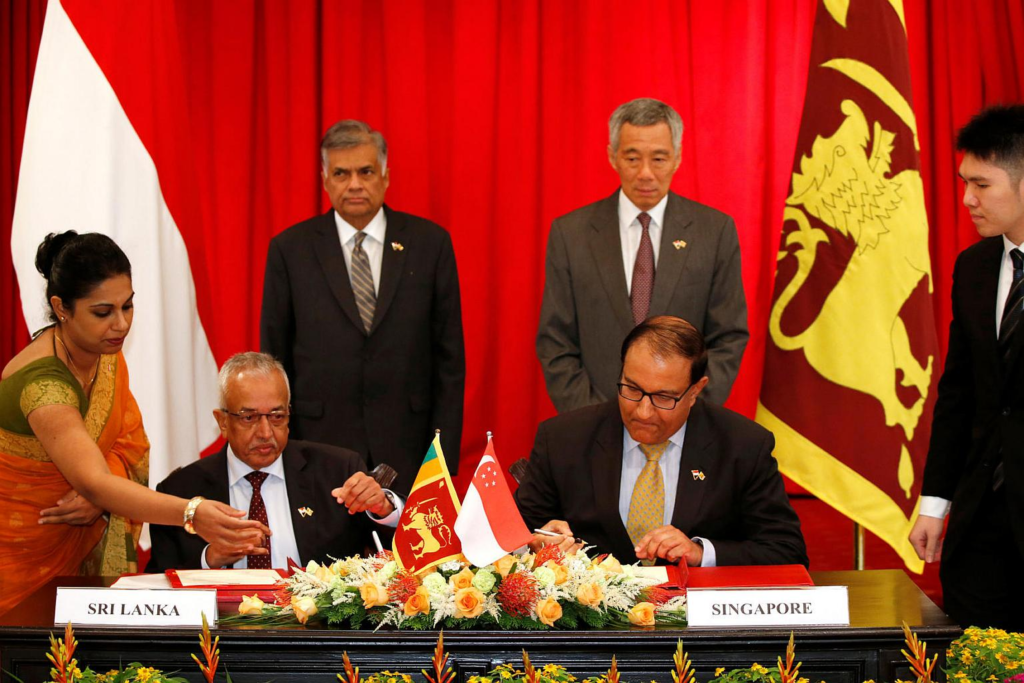
- Sri Lanka-Singapore Free Trade Agreement (FTA): Singapore registered Companies can bid on public contracts with specified Sri Lankan ministries and state-owned enterprises under national treatment principles. Sri Lanka also phases out basic customs duties and tariffs on 80% of its lines for Singaporean imports, while Singapore maintains duty-free access on nearly all imports from Sri Lanka.
None of this means you must relocate. As you will see below, most Sri Lankan founders register and run their Singapore company entirely remotely, without ever needing to relocate or even travel there.
Can a Sri Lankan Citizen Register a Company in Singapore?
Yes. Singapore places no restrictions on the nationality of company directors or shareholders. A Sri Lankan citizen — whether resident in Sri Lanka or overseas — can own 100% of a Singapore company, either in their personal capacity or through an existing Sri Lankan company acting as the corporate shareholder.
There is, however, one practical hurdle. Singapore’s company registration system, run by the Accounting and Corporate Regulatory Authority (ACRA), is accessed through an online portal called Bizfile. Filing directly on Bizfile requires “SingPass” authentication, which is only available to Singapore citizens, permanent residents, and certain work-pass holders. As a foreigner, you cannot file directly yourself.
This means that, as a Sri Lankan founder, you will need to appoint a Singapore-registered Corporate Service Provider (CSP) — sometimes called a filing agent or company secretarial firm — to submit your incorporation documents to ACRA on your behalf. This is completely normal; it is how the vast majority of foreign-owned Singapore companies are registered, and the entire process can be completed remotely, without ever needing a Sri Lankan or Singaporean government office visit.
Once submitted correctly, incorporation is usually approved within 2 to 5 working days, assuming your proposed company name and business activities do not require additional regulatory approval.
Choosing the Right Business Structure
Foreign entrepreneurs generally have three structures to choose from when entering the Singapore market. For almost all Sri Lankan founders, one option stands out clearly ahead of the rest.
Structure | Best For | Key Point |
|---|---|---|
Private Limited Company (Pte Ltd) | Most foreign founders, start-ups, SMEs, consultants | Separate legal entity, limited liability, can have 1–50 shareholders of any nationality, eligible for tax incentives. |
Branch Office | Established Sri Lankan companies extending operations | Legally an extension of the Sri Lankan parent, not a separate entity; parent remains liable for branch debts; no start-up tax incentives. |
Sole Proprietorship | Not generally suitable for foreign owners | No separate legal identity, unlimited personal liability, and generally requires local residency to register — rarely practical for a Sri Lankan founder. |
For the reasons above, the Private Limited Company (Pte Ltd) is the recommended structure for the overwhelming majority of Sri Lankan entrepreneurs. It offers a clean separation between your personal assets and the company’s liabilities, is the structure banks and investors are most comfortable working with, and unlocks Singapore’s start-up tax exemptions during your first few years of operation.
What You Need Before You Start
Before engaging a corporate service provider, it helps to understand the basic building blocks every Singapore Pte Ltd company must have in place:
- At least one director: Must be at least 18 years old, of any nationality, with a clean record (not an undischarged bankrupt or previously convicted of certain offences). You, as the Sri Lankan founder, can be this director.
- At least one shareholder: Can be an individual or a corporate entity, of any nationality. A single person can be both the sole director and sole shareholder.
- One local resident director: Every Singapore company must have at least one director who is ordinarily resident in Singapore — a citizen, permanent resident, or certain work-pass holders. Since most Sri Lankan founders do not have this, the CSP typically provides a “nominee director” for a fee. This person does not hold shares and has no involvement in daily operations; their role is purely to satisfy this residency requirement and handle compliance matters.
- A qualified company secretary: Must be appointed within six months of incorporation and be ordinarily resident in Singapore. Your CSP will typically provide this as part of their package.
- A registered local address: Every company needs a physical Singapore address for official correspondence — this cannot be a P.O. Box. Most Sri Lankan founders use a registered address service provided by their CSP, often with mail scanned and emailed to you.
- Minimum paid-up capital of S$1: There is no minimum capital requirement beyond this nominal amount, though most companies start with a slightly higher figure to appear credible to banks.
Because a Sri Lankan founder cannot personally fulfil the local director, company secretary, or registered address requirements, engaging a Singapore-based CSP is not just convenient — it is effectively mandatory. Since June 2025, all firms offering these services in Singapore must themselves be licensed by ACRA under the Corporate Service Providers Act, so it is worth confirming your chosen provider is properly registered.

Step-by-Step: How to Register Your Company
1. Decide on your business structure. As covered above, a Private Limited Company is almost always the right choice for a Sri Lankan founder.
2. Choose your company name and business activities. Your name must be unique and cannot contain restricted words. You will also need to select one or two Singapore Standard Industrial Classification (SSIC) codes describing what your business does — your CSP can help you pick the right ones. Some activities (such as financial services, education, or F&B) require additional licences before you can operate, so it is worth checking the GoBusiness licensing portal early.
3. Engage a licensed Corporate Service Provider. Since you cannot file directly through Bizfile, choose an ACRA-registered CSP to prepare and submit your incorporation documents. Reputable firms will also help you appoint a nominee director, company secretary, and registered address as part of a package.
5. Receive your Certificate of Incorporation. Once ACRA approves the application — typically within 2 to 5 working days — you will receive your company’s Unique Entity Number (UEN) and Certificate of Incorporation. Your company is now legally formed.
6. Open a corporate bank account and put compliance arrangements in place. With incorporation complete, the next step is banking (covered below), followed by setting up bookkeeping and tax compliance for your first financial year.
How Much Does It Cost?
Costs generally fall into two categories: a one-time set-up cost, and recurring annual compliance costs. Figures below are approximate market rates in SGD, with indicative LKR equivalents at a reference rate of roughly 1 SGD ≈ 260 LKR — actual rates fluctuate, so always check current figures with your bank or CSP before making a decision.
One-Time Registration Costs
Item | Fixed Cost (SGD) | Approx. Cost (LKR) |
|---|---|---|
ACRA company registration fee | S$300 | ≈ LKR 78,000 |
Business name reservation | S$15 | ≈ LKR 3,900 |
Total one-time government cost | S$315 | ≈ LKR 82,000 |
On top of this, your CSP will typically charge a service fee for handling the filing, which varies by provider — it is worth comparing a few quotes rather than accepting the first one you receive.
Annual / Recurring Costs
Item | Typical Cost (SGD) | Approx. Cost (LKR) |
|---|---|---|
ACRA annual filing fee | S$60 | ≈ LKR 15,600 |
Company secretary fee | From S$240/year | From ≈ LKR 62,000 |
Nominee director fee | From S$1,800/year | From ≈ LKR 470,000 |
Registered address service | From S$300/year | From ≈ LKR 78,000 |
Unaudited financial statements | From S$500/year | From ≈ LKR 130,000 |
Corporate tax return filing (Form C-S + ECI) | From S$500/year | From ≈ LKR 130,000 |
XBRL reporting* *(required only if there is a corporate shareholder in the company) | From S$500/year | From ≈ LKR 130,000 |
GST registration & Quarterly Reporting* *(required only if revenue exceeds S$1 million) |
From S$2,500/ year |
From ≈ LKR 656,000 |
Mandatory Audit * * (required only if revenue exceeds S$10 million) | Varies | Varies |
As a rough guide, most small foreign-owned Singapore companies should budget from minimally S$3,800 onwards for the first year (roughly LKR 1,000,000) to remain fully compliant, once secretarial, nominee director, accounting, and filing fees are combined. This is separate from any operating costs of the business itself.
The above fee may differ depending on your choice of service provider, structure and the complexity of the company setup.

Opening a Corporate Bank Account
Once your company is incorporated, you will need a corporate bank account to receive payments, pay suppliers, and manage your finances separately from your personal accounts. If you have clients in Sri Lanka who need to pay your Singapore company, you should invoice them in a major supported global currency like USD, EUR, or GBP. You generally have two options.
Digital Banks (Neobanks)
Providers such as Wise, Airwallex and Aspire offer fully online applications, usually approved within one to three weeks, with multi-currency accounts that are well suited to online businesses and freelancers. They are typically faster and much cheaper to set up, but do not offer cheque books, physical branches, or the full range of trade finance services that traditional banks provide.
Traditional Banks
Banks such as DBS, OCBC, and UOB offer the full range of banking services, including cheque books, trade finance, loans, and physical branch access, but applications generally take three to four weeks and some banks require an in-person visit for verification. OCBC now offers video-call verification for overseas applicants, which is worth asking about if you are unable to travel to Singapore. Do note that bank fees and charges would be significantly higher than the digital banks.
Whichever route you choose, banks will typically ask for your company’s ACRA business profile, passport copies and proof of address for all directors and shareholders, a short business plan or company profile, and, where possible, especially for traditional banks, evidence of real business activity such as signed contracts, invoices, letters of intent or a physical office lease. Having these ready in advance meaningfully speeds up approval.
It is worth noting that Sri Lankan banks do not currently operate branches in Singapore, so your Singapore banking relationship will need to be built independently with a Singapore-licensed bank or digital provider. However, if you already have an existing corporate banking relationship with Bank of China (BOC) Colombo Branch, they may be able to facilitate a corporate account opening under your Singapore entity with Bank of China (BOC) Singapore.
Both bank options support sending money in Sri Lankan Rupees (LKR) and you can also use your Singapore corporate debit card to buy items physically inside Sri Lanka. However, you cannot pre-fund the card with LKR. The card dynamically converts from your SGD or USD balance.
Moving to Singapore to Run Your Company
You do not need to relocate to own or direct a Singapore company — many Sri Lankan founders run their company entirely from Colombo or elsewhere. But if you eventually want to live and work in Singapore yourself, you will need an appropriate work pass. The two most relevant options are:
- EntrePass: Designed for entrepreneurs who want to start and actively run an innovative business in Singapore. It generally requires the business to meet certain innovation or funding criteria. You cannot apply for this pass on your own. You must be sponsored by an approved Venture Capital Firm in Singapore (e.g. Antler).
- Employment Pass: The standard route if you plan to employ yourself in your own Singapore company. It comes with minimum salary and qualification requirements set by the Ministry of Manpower, which are reviewed periodically. The monthly salary you would need to pay yourself as a director of your company starts from SGD$8,000 upwards depending on your age, experience and educational qualifications.
If you intend to bring your spouse, children, or parents with you to Singapore, only the Employment Pass route currently allows for dependent passes, and it comes with a higher salary threshold than the minimum required for a standalone application. If relocation is part of your longer-term plan, it is worth discussing pass eligibility with your CSP before you incorporate, since it can influence decisions such as initial paid-up capital.

A Note on Sri Lanka's Foreign Exchange Rules
This is one area where the process differs meaningfully from guides written for other countries, and it deserves special attention if you are resident in Sri Lanka.
Sri Lanka regulates outward remittances and overseas investment under the Foreign Exchange Act, No. 12 of 2017, administered by the Central Bank of Sri Lanka (CBSL). If you are resident in Sri Lanka and plan to remit funds abroad to capitalise your Singapore company, this generally needs to be done through an Outward Investment Account (OIA) maintained with a licensed commercial bank acting as an authorised dealer.
Investment limits are periodically reviewed by the CBSL. As of mid-2026, unlisted Sri Lankan companies have generally been permitted to invest up to around USD 200,000 overseas under standard permissions, with listed companies permitted higher amounts, and any investment above roughly USD 2 million requiring special approval. Separately, the CBSL has, from time to time, issued temporary orders restricting or suspending certain outward remittance permissions in response to the country’s foreign currency reserve position — these orders are reviewed and reissued every few months.
In practical terms, this means that before transferring funds from Sri Lanka to capitalise or fund your Singapore company, you should check the current rules directly with your Sri Lankan bank’s international/treasury desk or the CBSL’s Department of Foreign Exchange, since the applicable limits and permissions can change. Many Sri Lankan founders work around early-stage capital needs by using modest paid-up capital (even the statutory minimum of S$1) and building up company funds later through actual business revenue received directly into the Singapore bank account, rather than large upfront transfers from Sri Lanka. If a larger transfer is planned, budgeting extra time for CBSL or bank-level approval is advisable.
Common Mistakes to Avoid
- Choosing a CSP based on price alone. Extremely cheap nominee director or secretarial packages sometimes come with hidden renewal fees or poor compliance support. Compare a few providers and read what is actually included.
- Underestimating annual compliance costs. The registration itself is cheap; it is the ongoing secretarial, nominee director, and accounting fees that add up. Budget for the full annual cost before you commit.
- Ignoring Sri Lankan foreign exchange rules. Sending large sums abroad without checking current CBSL and bank requirements can cause delays or compliance issues on the Sri Lankan side.
- Assuming a bank account is guaranteed. Banks assess each application individually. Having a clear business plan, a real website, and evidence of business activity significantly improves your chances.
- Not planning for tax obligations. Even a dormant company must file annual returns with ACRA and IRAS. Missing deadlines can lead to penalties and, in serious cases, disqualification of directors.
Conclusion
For Sri Lankan entrepreneurs looking to expand internationally, raise the credibility of their business, or simply access better banking and payment infrastructure, registering a company in Singapore is a realistic and well-trodden path. The process is remote-friendly, relatively quick, and does not require you to relocate.
The main things to get right are choosing the correct structure (almost always a Private Limited Company), working with a properly licensed Corporate Service Provider since you cannot file directly with ACRA yourself, budgeting realistically for both set-up and annual compliance costs, and — specifically as a Sri Lankan resident — checking current Central Bank of Sri Lanka rules before remitting any significant capital abroad.
With the right preparation, most Sri Lankan founders find that a Singapore company & Corporate bank account can be up and running within about 3-4 weeks of engaging a service provider, giving their business a genuine international footing.
Frequently Asked Questions
1. Can I register a Singapore company from Sri Lanka without travelling there?
Yes. The entire registration process, and most bank account applications, can be completed remotely with the help of a Singapore-based Corporate Service Provider. Some traditional banks may still request an in-person or video verification for certain applicants.
2. How long does the registration process take?
Typically 2 to 5 working days once your documents are submitted, assuming your company name and business activities do not require additional government approval. Bank account opening would take approximately 2-4 weeks.
3. Do I need a local partner or shareholder in Singapore?
No. You can own 100% of your Singapore company as a Sri Lankan citizen. You will, however, need a locally resident nominee director and company secretary, which your service provider will normally arrange.
4. What is the minimum capital required to start?
Legally, just S$1. Many founders start with a modest amount and increase it later, particularly if it helps with bank account approval or future visa applications.
5. Will I need to pay tax in both Singapore and Sri Lanka?
Your Singapore company will be taxed in Singapore at a maximum rate of 17%, with partial exemptions available in the first three years starting from 3% tax rate. Your personal tax position in Sri Lanka depends on your individual circumstances and any dividends or income you draw from the company, so it is worth speaking to a tax adviser in both countries to understand your full picture.
6. Can I move to Singapore later if my company grows?
Yes. Many founders start by running their company remotely and apply for an Employment Pass or EntrePass once the business has grown enough to justify relocation.
7. How can I find out more about the business opportunities in Singapore?
You may consider joining the Singapore Sri Lanka Business Association for networking and cross-border collaboration opportunities.